

Beyond the Glow
thoughts on 'giving childhood back'

There is much talk at present of ‘giving children their childhood back’ as spearheaded by Jonathan Haidt on why ‘a screen based childhood is not a human childhood’ and how screens have re-wired childhood. But what actions can we take, as society, to support parents and teachers, many at their wits’ end, with this effort? What exactly, in concrete terms, can we give back?


The ongoing discourse - we’ve finally moved past doubtful ‘debate’ - is picking momentum fast. All eyes are on the restriction of toxic influences on childhood: the ban on smartphones in schools; the curfew on social media for under 16s; the exponentially growing concerns about young people’s mental health, social, sexual and physical development, and skewed understanding of privacy; the depleted, if not severed, personal connections, especially within the family space1. This debate, surprisingly welcome by young people themselves, stems largely from Haidt’s seminal arguments in The Anxious Generation, where he uncovered how childhood has become increasingly reorganised around the smartphone. This issue has finally turned from background noise to front-stage argument. It has also confirmed some of our fears that before long we’ll be looking back at how freely we handed over smart devices to kids. A woeful hindsight similar to the realisation that cigarettes or Coca Cola were harmful from the beginning.2
While those in power tackle the means to a necessary end, the time feels ripe for the rest of us to consider more closely what, and above all, how, we can restore childhood to an generation increasingly lost. There are real opportunities for more creative approaches to holiday camps (such as Beaver Tree Camp), increasingly popular initiatives to reconnect with nature (the Education Nature Park, forest schools, the WWF Happy By Nature programme, rewilding opportunities in the Carpathian mountains, to name but a few), while other imaginative analogue alternatives are surely being conjured as I write.
The Anxious Generation Movement proposes Four Norms to Roll Back the Phone-Based Childhood:
No smartphones before high school
No social media before 16
Phone-free schools, from bell to bell
More independence, free play, and responsibility in the real world
It is interesting how currents of an age, even from different angles of the human experience (perhaps because of it), eventually end up with concomitant goals. The smartphone ban is not ostensibly linked to the climate crisis, nor to the eco-drive to reconnect with indigenous wisdom - and yet the goals are the same: a return to the recognition of our symbiotic existence with Mother Earth, our relationship with it and with each other - but also, delightfully, with our inner worlds. This symbiotically engaged existence has been for too long contaminated by the other human drive, for progress, to the point that it has now reached beyond endangering the Blue Planet, right into our children’s social, emotional, creative and intellectual lives.
For me (and I know I’m far from alone in this), one aspect of childhood I like bringing back to my children alongside reconnecting with Nature, is the experience of the Arts. A significant aspect of giving childhood back entails recovering embodied, relational and imaginative experiences through unstructured time, responsibility, conversation, making and play. Sustained exposure to the arts belongs to this wider philosophy of reconnection. The Arts ask of us to see and hear, move and make, interpret and discover how much more the world sparkles when lit by more than one glow. Crucially, they also lead us to uncover the joy of our own inner resources.
This is the strand I want to follow here - primarily because it shaped my own childhood so profoundly, in circumstances where the Arts were both instrumental to political control and unlikely spaces of imaginative freedom.
“The arts celebrate multiple perspectives. One of their large lessons is that there are many ways to see and interpret the world.”
Elliot W. Eisner, The Arts and the Creation of Mind
This essay builds on a recent talk to my students, weaving stories and themes explored in last summer’s Visible Strings and Freedom Spaces. The theme for the talk was Light in the Darkness. Readers of Visible Strings will recognise the puppet theatre of my childhood, leading here explicitly towards other forms of freedom that artistic expression made possible in the dark and controlled world of a 1970-80s Eastern European totalitarian regime, where pre-digital childhood was materially restricted.
I recounted the story of when, back in Romania for the summer of 2025, my companions found it amusing when I said I’d skip the mountain hike for a marionette show - I was the only adult unaccompanied by a child in the tiny auditorium, where the ten worn out benches of memory had been replaced by plush chairs.
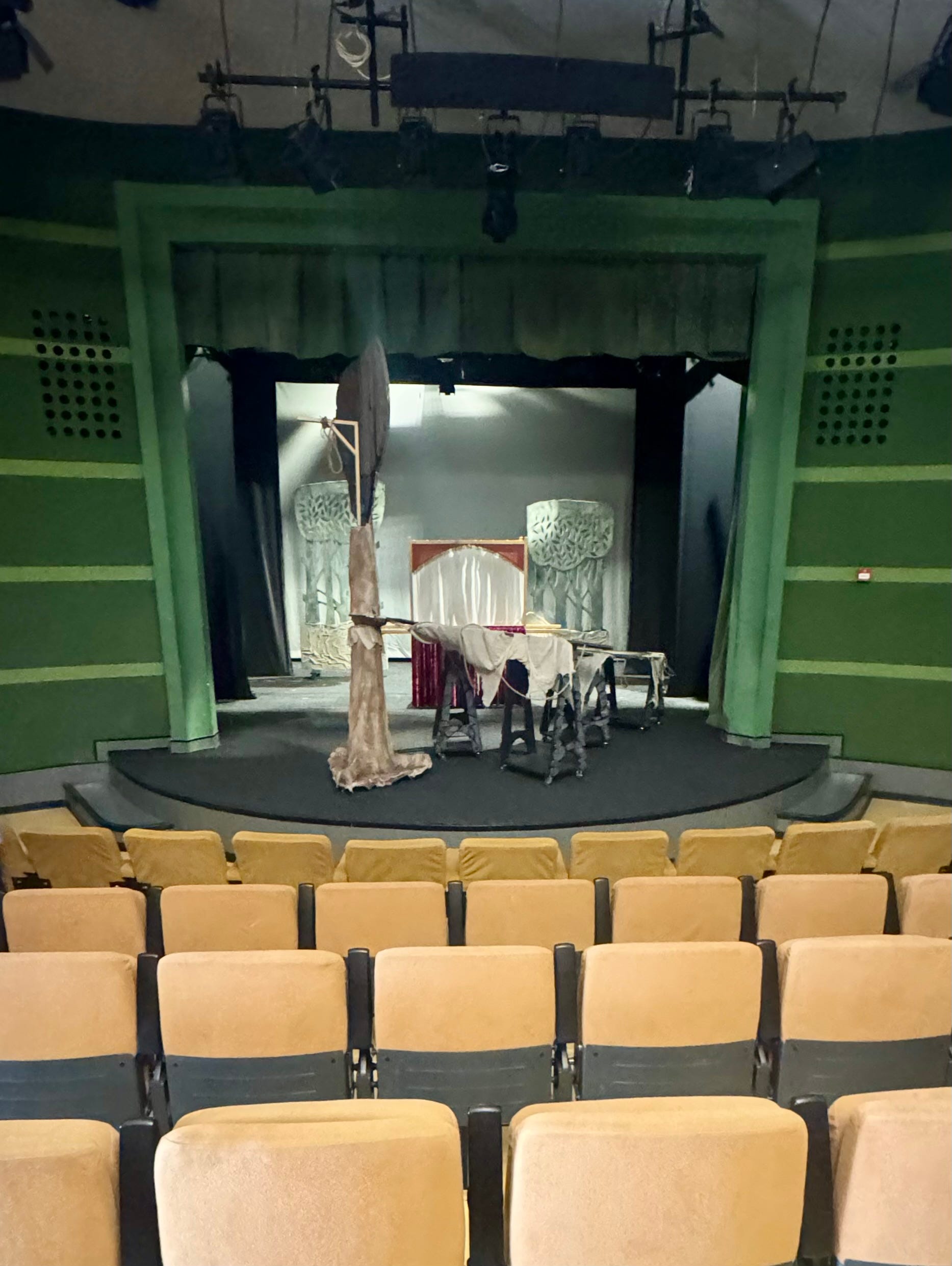
In the communist Romania of my childhood, even in the decades of food rationing, the Arts provision remained generous: from opera to theatre, from art exhibitions to spectacular propaganda displays. It’s easy to take for granted the uncommon power the Arts have on us, even when we are only tangentially exposed to them. Totalitarian systems have always understood how this power reached far beyond entertainment. Such cultural generosity was strategic arts and cultural pursuits are ways of enthralling attention and manufacturing feeling.
Whether communist, fascist or fundamentalist, indoctrination and propaganda are especially effective when they understand spectacle. Picture, on a typical communist May Day3, a sports arena where young people are choreographed into colourful shifting patterns outlining detailed portraits and spelling out slogans, streets lined with pioneers armed with red carnations and little red flags - and marching band music, all in celebration of a fabricated record-breaking crops and industrial production. And of the Supreme President, of course.


Ridiculous though this may sound, we loved the multicoloured noise, the electrifying sense of purpose and belonging. For our parents it meant a day off physical labour, in full sunshine. For us kids, a day off school. We, children, didn’t for a second question the performative theatricality of it. Nor how this spectacle (in standardised outfits of red, yellow, blue – the colours of our country) sat alongside the rationing of food, gas, electricity; homework by candle light; or the winter water saved in bathtubs which freezed so hard that we’d pretend to skate on it.
We worshipped our great Communist Father on cue, in confident voices - with flags, slogan placards and impressive human formations spelling out the fabricated glory of his name. We were too young to comprehend the bedazzling machinery of totalitarian power, legitimised by Berlin Wall and Iron Curtain. A power which terrorised our parents into not breaking the spell – for fear of losing their livelihood, if not their lives.
Even warped into propaganda, the Arts still work through the reality of the world as we know it - its physical and emotional dimensions: rhythm, colour, voice, movement. We feel what we see before we understand a message. In those moments when we perform, make or watch something, we get to suspend our disbelief, we open differently to whatever life throws at us, we get to live more fully. In a context of scarcity, creative activities and celebrations, alongside reading and spending time in nature, were, quite literally, all we had. But in any context the creative impulse – the bliss of ‘flow’ - is irresistible, even therapeutic.
We sing, dance, tell stories as a life-affirming way of coming together, but also to express the inexpressible: courageous artists across history found ways to weave dissent into the very fabric of censored or propaganda work. This is famously the case with Palestinian embroidery, Trajan’s column in Rome, Lu Xun’s allegorical satire of authoritarian culture, or Dmitri Shostakovich’s 5th Symphony, all of which embed irony and tension in scores that satisfy a political power - while unsettling it from within. By disguising radical critique within the symbolic messages it broadcasts, subversive creativity can sow the light of hope.
In a totalitarian context, the power of the Arts is further complicated by its re-construction of reality, thus controlling minds: firstly by inspiring trust, then by twisting trust into fear. For those growing up under dictatorship, this fear is normalised as loyalty to the ‘supreme’ communist figurehead. The President’s portrait featured on the first page of every school book and reigned larger-than-life above the teacher’s desk. Before the first lesson of the day we sang the national anthem - a hymn to His glory, the communist colours, the agricultural fertility and geographic magnificence of one of the most beautiful and (at the time) oppressed, of European countries.
Viktor Shklovsky said that the purpose of art is to defamiliarize, to break the dulling force of habit so that we can see afresh the ordinary things of this world: and precisely this is the strange but also wonderful thing about artistic expression in dark times. While they indeed controlled a hungry and terrorised population through indoctrination - by re-writing everyday life - even censored songs, stories, artwork and poetry were infused with wonder.
In What Good Are the Arts, John Carey argues for the vital role of creativity in ordinary life - more than as luxury or privilege - because of its power to enrich and magnify human experience, to shine the light on possibility. Indeed, under the tactical benevolence of a tormentor’s hand, or maybe with just more luck than in other dictatorships, Romanian culture was not all propaganda: it saved a place for certain ‘safe’ classics, including international ones (any non-Western and pre-20th century Western authors, artists, musicians, film makers…). By accompanying my father, a theatre sound engineer, on tours, after 18 performances of Shakespeare’s As You Like It, I was able to lead my siblings into endless role-play in our apartment living room (which overnight functioned as our bedroom), line by line Shakespeare in translation. This game alternated with tough Arctic explorations, tropical jungle challenges and even excursions into old age, when we imagined what it would be like to become like the rustic old men and women sat in porches by the side of country roads: frail, wise and full of stories.
Although contextually we lived a comfortable life, we owned fewer toys than we could count by the fingers of our hands. Due to the 100% employment policy of the communist system, with both parents working full time, in the summer holidays we were left either unattended for hours on end, or taken to our grandparents’ flat. This made role play, imaginary toys, story-telling and writing, and later, reading, the only forms of entertainment available. Our grandparents took us to parks, the library or swimming pool, or further afield on day trips to dreamy Carpathian castles. And of course, to the puppet theatre in the old town centre of Brasov:
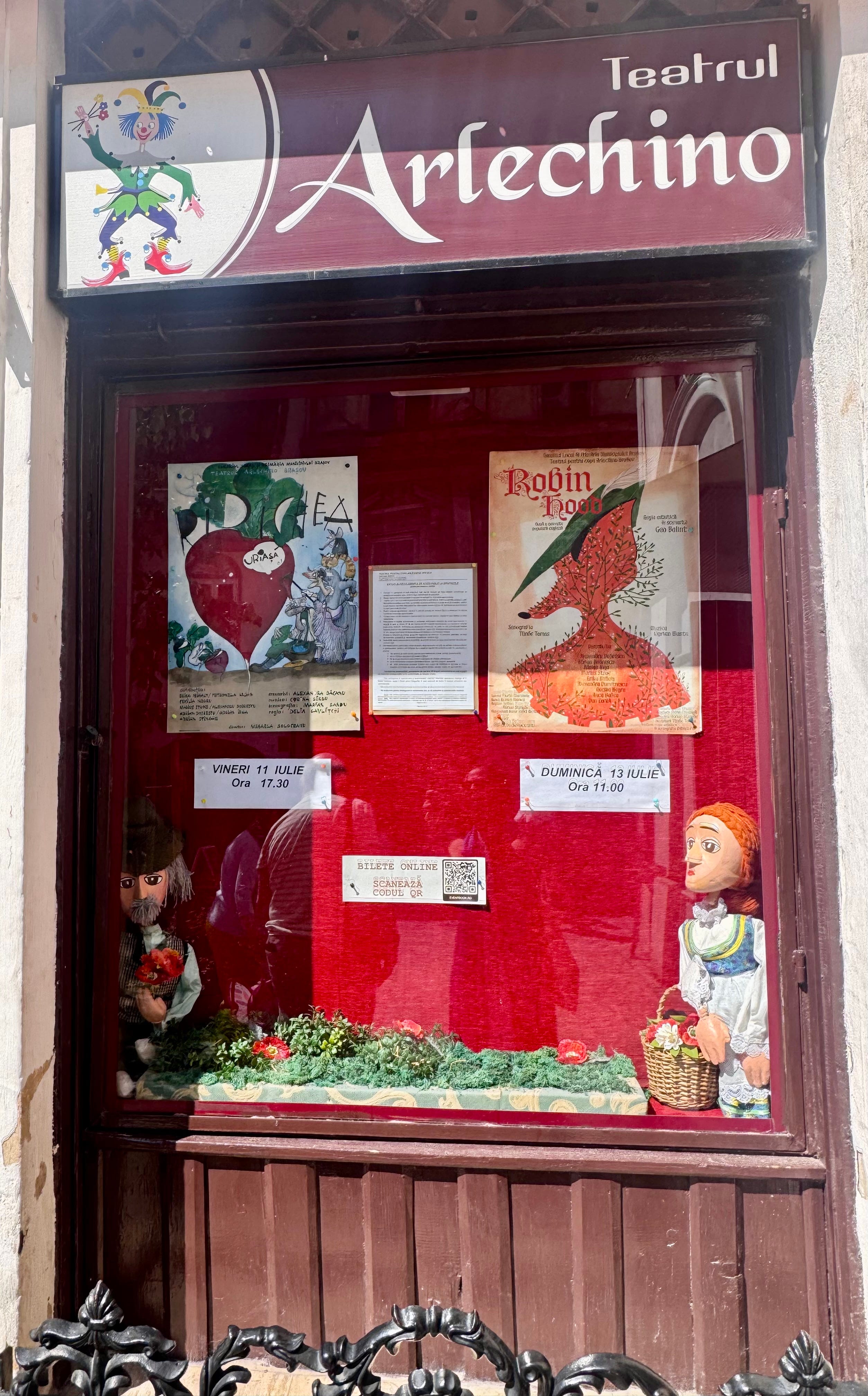
The tiny auditorium of Puppet Theatre Arlechino was founded by the communist government of 1949 for the entertainment of small children. This diminutive venue has always lived in a slim Baroque building, just off the historic square of my town. It’s a crazy thought that, across decades, several generations - from that of my grandparents, to my own kids - have clapped hands of a Sunday morning to the same little stage.
As the usher unhooks the velvet rope and we settle for the opening gong, this womb of stories takes us back in time: firstly, there is the layered cultural history of Robin Hood: from old English ballad to novel, to translation from English into Romanian, then this 45 minute page-to-stage adaptation of its most entertaining essentials. Secondly, there is the magical suspension of disbelief particular to the experience of puppet theatre: the human actors appear first, to rouse interest with sing-song context; we grow familiar with their voices and mannerisms, anticipate with excitement the plush protagonists they’ll bring to life. In green and brown, no make-up, they come physically close to us, their uplifting energy enchants.
In the silence they leave behind, the magic takes hold: there under the first spotlight, emerges the first marionette: a monkish badger in brown hessian, carrying a satchel. Immediately, the moral tone is clear - the ordinary people of this world are the heroes of the show. By the time Robin Hood (a fox) and Little John (a thieving teddy) enter, we are hooked. The bad head of state, Prince John, is a bright orange tiger in red tights and golden shoes, sucking his thumb. The story is funny, exact, and deeply readable.
I’m mesmerised by the choreography of it, the deft manipulation of puppets on strings, each animated by four human hands but only one voice, each injected with consciousness, by the practised expressivity of fingers. We feel its ‘aliveness’.
When we watch or tell a story, the illusion works because we want it to work: we suspend our disbelief and our attention takes the show as truth. Indeed, performance becomes the only truth. Playfully stripped of violence but morally serious, this show bravely asks questions about justice, greed, charity, authority. It conjures the possibility of the weak to grow strong. It restores power to the disenfranchised.
By the time the glitzy, larger than life puppet of the rightful king, Richard Lionheart enters, I am taken aback — why do we need him? Now? To me, the more interesting power has already been claimed by Sherwood Forest and its mischievous everyday heroes. We clap joyfully in the wake of resolved moral conflict.
In reverse to the opening act, each character bows for applause, first as marionette, then as human. I appreciate, once again, the unpainted faces of these wonderful humans whose vocation is to enthral. This hour of time travel has unravelled in the guise of a language I thought slipping from my grasp, retelling a narrative originally from my second language, this, of my adoptive country. Artistry has stitched together rags of torn time into something new, richer and wonderfully luminous.
Back out into the sunny square, I wander into the Arts Centre next door where, up the grand marble staircase, I’m sucked into a crowd of kids the next age up from those watching the puppets. These girls and boys, also in their Sunday best, dash upstairs hyped about an acting workshop, booked first-come-first-served and not by body type or “natural” talent selection, like in my day.
For me, this isn’t just an exciting sight: in the bright voices and rosy cheeks of these kids, I witness one of our most powerful instincts: to make, express and embody a story, and in doing so live freely, but together. And - at least for a moment in time - retreat from the digital glow.
https://www.anxiousgeneration.com
there’s a tendency to identify 1950s Cola for babies adds as ‘AI modified’ but even so, I came across such adverts already in the Noughties, teaching advertising for the IB Language and Literature course
alongside marking the beginning of summer, 1 May is also the commemoration of the historic struggle for the 8h work day
Lovely to have you back! I’m stunned by how imaginatively one can play even growing up in a communist country - there is something that can never be stolen from children
Very much enjoyed reading this – thank you